Michigan Energy Rebates 2026
Michigan residents can access federal HEAR and HOMES rebates in 2026, administered through the Michigan Public Service Commission and the Department of Environment, Great Lakes, and Energy (EGLE). DTE Energy serves the Detroit metro and southeastern Michigan while Consumers Energy covers much of central and western Michigan. The state also offers the MI Saves green bank program for low-interest financing on efficiency upgrades.
Program status and income limits on this page were last checked against official state and federal sources on . These programs change without notice.
HOMES Rebate Program in Michigan
| Income Level | Max Rebate | Cost Coverage |
|---|---|---|
| Low income (≤80% AMI) | Up to $8,000 | 80% of project cost |
| Moderate income (80-150% AMI) | Up to $4,000 | 50% of project cost |
| Above 150% AMI | Not eligible | N/A |
Michigan's MiHER program covering HOMES and HEAR is live statewide through administrator CLEAResult. “The program started in fall of 2024 with pilot homes in the Upper Peninsula.” Source: Michigan Department of Environment, Great Lakes, and Energy (EGLE).
Official HOMES Program PageHEAR (HEEHRA) Rebates in Michigan
| Equipment | Max Rebate |
|---|---|
| Heat Pump HVAC | Up to $8,000 |
| Electrical Panel | Up to $4,000 |
| Wiring Upgrade | Up to $2,500 |
| Heat Pump Water Heater | Up to $1,750 |
| Insulation & Weatherization | Up to $1,600 |
| Electric Stove/Cooktop | Up to $840 |
Maximum total: $14,000 per household (low-income, ≤80% AMI). Moderate income (80-150% AMI) can receive up to $7,000.
Official HEAR Program PageFind Pre-Screened Installers in Michigan
Get free, no-obligation quotes from certified local contractors for heat pumps, solar, and insulation — and see your total after Michigan rebates.
Free quotes · No commitment · Local contractors in Michigan
Michigan State Incentive Programs
MI Saves
Michigan's green bank offering low-interest financing for home energy improvements including insulation, HVAC upgrades, and weatherization. Works alongside HEAR and HOMES rebates to reduce out-of-pocket costs.
Learn moreMichigan Weatherization Assistance Program
State-administered federal WAP program providing free weatherization services (air sealing, insulation, heating system tune-ups) for income-eligible Michigan households.
Learn moreEGLE Energy Programs
Michigan Department of Environment, Great Lakes, and Energy oversees federal energy efficiency funding and manages HOMES and HEAR program implementation for the state.
Learn moreUtility Rebate Programs in Michigan
DTE Energy
DTE Energy offers energy efficiency rebates for smart thermostats, insulation upgrades, and high-efficiency HVAC systems for residential customers. Visit dte.com for current program amounts.
Consumers Energy
Consumers Energy's efficiency programs include rebates for heat pump installations, home energy audits, and appliance upgrades. Visit consumersenergy.com for current program details.
Area Median Income (AMI) in Michigan
HOMES and HEAR rebate amounts depend on your household income relative to the Area Median Income in your area. AMI varies by county and household size.
| Area | 80% AMI (Family of 4) | 150% AMI (Family of 4) |
|---|---|---|
| Wayne County | $83,850 | $157,200 |
| Kent County | $85,300 | $159,900 |
| Ingham County | $82,100 | $153,900 |
| Genesee County | $66,900 | $125,400 |
| Washtenaw County | $106,800 | $200,200 |
| Ottawa County | $90,950 | $170,500 |
Eligibility is set by county and household size. The 80% figures are the HUD FY2026 income limits published for each county and are reproduced as-is. HUD does not publish a 150% limit, so that column is computed from the 80% limit; checked against Minnesota's official 2026 county table, the method lands within $200 on every county, but where your state publishes its own table, that table governs. Figures are for a 4-person household and change with household size.
Use Our Calculator to Check EligibilityBefore you spend money on this
Energy Rebate Calculator is an independent website. It is not affiliated with, endorsed by, or operated by the U.S. Department of Energy, Michigan, or any other government agency, and nothing on this page is an offer, an application, or a promise of payment.
Federal and state rebate programs launch, pause, change their amounts and run out of funds without notice, and eligibility rules differ by county, household size, housing type and sometimes by region within a state. Most programs also refuse to pay for work completed before their launch date. Figures here are published to help you understand roughly where you stand, not to be relied on as the final word.
Confirm your eligibility and the current terms directly with the administering agency, and get written confirmation, before you sign a contract or buy equipment. Where this page cites an official source, that source governs. If you spot something out of date on this page, tell us and we will correct it.
Data vintage. The rebate data on this page was last updated on . We publish this date so you can judge for yourself how current the figures are.
Frequently Asked Questions
What energy rebates are available in Michigan in 2026?
In 2026, Michigan residents have access to two active federal rebate programs: HEAR (Home Electrification and Appliance Rebates) offering up to $14,000 for appliances like heat pump HVAC, heat pump water heaters, and electric stoves; and HOMES (Home Owner Managing Energy Savings) offering up to $8,000 based on whole-home energy savings. Both programs are administered through Michigan EGLE. Additionally, MI Saves offers low-interest green loans, and utilities DTE Energy and Consumers Energy offer their own efficiency rebates.
Are federal tax credits still available in Michigan?
No. The One Big Beautiful Bill Act (P.L. 119-21, signed July 4, 2025) terminated Section 25C (energy efficiency improvements) and Section 25D (residential clean energy, solar, battery, geothermal) federal tax credits for any installations completed after December 31, 2025. If you installed qualifying equipment in 2025 or earlier, you can still claim the credit on your 2025 tax return. For 2026 installations, HEAR and HOMES rebates are the primary federal benefit available.
Does Michigan have income limits for HEAR and HOMES rebates?
Yes. HEAR rebates are available to households earning up to 150% of the Area Median Income (AMI), with the maximum rebate amounts going to those at or below 80% AMI. In the Detroit metro, 80% AMI for a 4-person household is approximately $70,400; in Grand Rapids it's about $77,600. HOMES rebates also prioritize lower-income households, with those below 80% AMI eligible for up to $8,000 and moderate-income households eligible for up to $4,000.
What does MI Saves offer and how does it work with rebates?
MI Saves is Michigan's green bank that provides low-interest financing (often 0–7% APR) for home energy upgrades including insulation, smart thermostats, heat pumps, and weatherization. It can be combined with HEAR and HOMES rebates, you apply the rebate to reduce your project cost and finance the remainder. Participating contractors are listed on the MI Saves website at misaves.com.
Do DTE Energy or Consumers Energy offer additional rebates in Michigan?
Yes, both major Michigan utilities offer their own energy efficiency programs on top of the federal HEAR/HOMES rebates. DTE Energy's Residential Energy Efficiency program provides rebates for smart thermostats, insulation, and HVAC upgrades. Consumers Energy's Energy Efficiency program offers similar rebates for heat pumps and home energy audits. Visit dte.com or consumersenergy.com for current program details, as rebate amounts and eligibility can change annually.
How do I apply for HEAR rebates in Michigan?
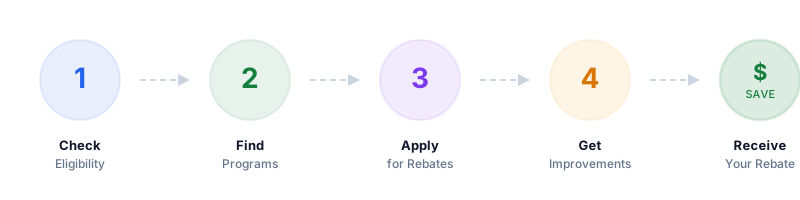
Michigan's HEAR rebates are applied as point-of-sale discounts through EGLE-approved contractors, you pay the reduced price directly. To start: (1) confirm your household income is below 150% AMI; (2) find a participating HEAR contractor via michigan.gov/egle or by contacting your utility; (3) get a quote for qualifying equipment (heat pump, HPWH, electric stove, panel upgrade); (4) have the contractor apply the rebate at invoice. Contact EGLE at michigan.gov/egle for the current approved contractor list and funding availability.
How to Claim Your Michigan Rebates