Energy Rebates 2026: HOMES, HEAR & How to Stack Rebates Up to $25,000
What Changed in 2026: The OBBB Impact
The energy rebate landscape looks drastically different in 2026. On July 4, 2025, President Trump signed the One Big Beautiful Bill (OBBB, Public Law 119-21) into law, and two of the most popular federal energy incentives vanished overnight.
Here's what happened: the 25C Energy Efficient Home Improvement Credit and the 25D Residential Clean Energy Credit were terminated for any property placed in service after December 31, 2025. If you were counting on a 30% tax credit for solar panels or up to $3,200 back on a heat pump, that door closed on New Year's Day.
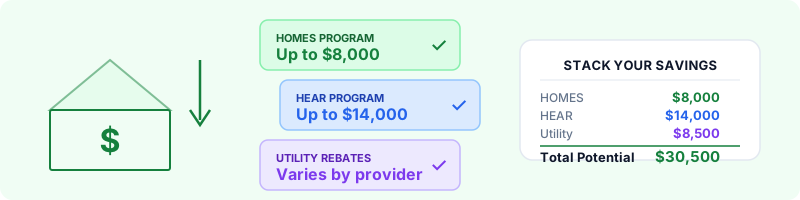
But the picture isn't all bleak. Two major federal rebate programs survived the OBBB, and they're now the backbone of residential energy savings in 2026:
| Program | Status in 2026 | Maximum Rebate | How It Works |
|---|---|---|---|
| 25C Tax Credit | EXPIRED | Was up to $3,200/year | Terminated by OBBB |
| 25D Tax Credit | EXPIRED | Was 30% (no cap) | Terminated by OBBB |
| HOMES Rebates | ACTIVE | Up to $8,000 | State-administered, upfront rebate |
| HEAR Rebates | ACTIVE | Up to $14,000 | State-administered, point-of-sale |
The HOMES and HEAR programs come from the Inflation Reduction Act (IRA), backed by a combined $8.8 billion federal budget. Unlike the expired tax credits, these aren't deductions on your annual return — they're direct rebates that reduce what you pay upfront.
There's a catch, though. Funds run until depleted or September 30, 2031 — whichever comes first. Demand is high and allocations vary by state. Act sooner rather than later.
Use our free rebate calculator to see exactly which programs you qualify for based on your state, income, and planned improvements.
Federal Energy Rebate Programs Still Available
Two federal programs survived the OBBB and are actively distributing billions of dollars to homeowners through state-level agencies. Both are funded by the Inflation Reduction Act and administered by individual states, which means eligibility rules, application processes, and available funding vary depending on where you live.
One critical difference from the old tax credits: HOMES and HEAR are direct rebates, not tax deductions. You don't need to wait until you file your taxes to see the money. HOMES rebates come as checks or contractor payments after your project is done, and HEAR discounts are applied right at the register when you buy eligible equipment. For many homeowners — especially those who don't owe much federal income tax — rebates are actually more valuable than credits ever were.
| Detail | HOMES Program | HEAR Program |
|---|---|---|
| Full Name | Home Owner Managing Energy Savings | Home Electrification and Appliance Rebates (HEEHRA) |
| Federal Budget | $4.3 billion | $4.5 billion |
| Max Rebate (Low Income) | $8,000 | $14,000 |
| Max Rebate (Moderate Income) | $4,000 | $7,000 |
| Type | Whole-home retrofit | Individual appliance |
| Income Limit | ≤150% Area Median Income | ≤150% Area Median Income |
| Funding End | When depleted or Sept 30, 2031 | When depleted or Sept 30, 2031 |
The key difference: HOMES covers whole-home energy retrofits measured by total energy savings, while HEAR gives per-appliance point-of-sale discounts. Many homeowners can qualify for both — more on stacking rebates below.
Worth noting: both programs are first-come, first-served. When a state's allocation runs dry, that's it until (or unless) Congress appropriates more. States with high demand — California, New York, Massachusetts — could see their funds depleted faster than expected. Don't wait to see what happens; check your eligibility now.
HOMES Program: Up to $8,000 for Home Retrofits
The HOMES program rewards homeowners who make comprehensive energy efficiency upgrades. Rather than rebating individual appliances, it focuses on overall energy reduction for your entire house.
How HOMES Rebates Work
A certified energy auditor or approved modeling software evaluates your home's current energy use, then projects how much energy your planned upgrades will save. The bigger the reduction, the higher your rebate:
| Energy Reduction | Low Income (≤80% AMI) | Moderate Income (80-150% AMI) |
|---|---|---|
| 20%+ energy savings | Up to $4,000 (80% of cost) | Up to $2,000 (50% of cost) |
| 35%+ energy savings | Up to $8,000 (80% of cost) | Up to $4,000 (50% of cost) |
What Qualifies
- Insulation and air sealing
- HVAC system upgrades (including heat pumps)
- Window and door replacements
- Building envelope improvements
- Any combination that hits the energy reduction threshold
Real-World Example
A household earning $52,000 in a county with $65,000 AMI qualifies as low income (≤80% AMI). They spend $12,000 on insulation, air sealing, and a heat pump installation. Energy modeling shows 38% projected savings. Their HOMES rebate: $8,000 (80% of $12,000, capped at $8,000). Out-of-pocket cost: $4,000.
Multifamily buildings also qualify under HOMES, with rebates scaling to $400,000 for large projects. Check your state program for multifamily specifics.
Check your specific state's HOMES program status on our state rebate pages, or run the numbers with our insulation rebate calculator.
HEAR Program: Point-of-Sale Appliance Rebates
The HEAR program (formally HEEHRA — Home Electrification and Appliance Rebates) works differently from HOMES. Instead of measuring whole-home savings, HEAR provides fixed-dollar rebates on specific electrification equipment, applied directly at the point of sale.
That means the discount shows up on your receipt. No filing a tax return. No waiting months for a check.
HEAR Rebate Amounts by Equipment
| Equipment | Maximum Rebate | Calculator |
|---|---|---|
| Heat Pump (HVAC) | $8,000 | Calculate your rebate |
| Electrical Panel Upgrade | $4,000 | Calculate your rebate |
| Wiring Upgrade | $2,500 | — |
| Heat Pump Water Heater | $1,750 | Calculate your rebate |
| Insulation & Weatherization | $1,600 | Calculate your rebate |
| Electric Stove / Cooktop | $840 | — |
| Heat Pump Clothes Dryer | $840 | — |
Income-Based Caps
HEAR rebates are income-dependent. Your total across all appliances can't exceed:
- $14,000 for households at or below 80% Area Median Income (100% of costs covered)
- $7,000 for households between 80-150% AMI (50% of costs covered)
- $0 for households above 150% AMI (not eligible for HEAR)
A practical scenario: you earn $55,000 in a county where 80% AMI is $60,000. You buy a heat pump ($8,000 rebate) and a heat pump water heater ($1,750 rebate). Total HEAR savings: $9,750, well within the $14,000 cap.
Read our full HEAR Program Guide for detailed eligibility rules and participating retailers by state.
State Energy Rebate Programs
Since HOMES and HEAR are state-administered, each state decides when to launch, how to handle applications, and whether to add its own incentives on top. This creates a patchwork where your savings depend heavily on your ZIP code.
States That Returned Funds
Florida declined its IRA HEAR/HOMES allocation. Florida residents must rely on utility programs (FPL, Duke Energy Florida, TECO, JEA) and any state-specific incentives. See our Florida rebates page for what's available.
What About the Other States?
The majority of states have launched or are launching programs. Some states are weeks or months away from opening applications. Getting your home assessed now puts you first in line when funding opens.
Take Illinois as an example: the HEAR state program through DCEO is pending full launch, but ComEd and Ameren Illinois run active appliance rebates and efficiency programs right now. Most states follow this same pattern — utility rebates are live even when the state HEAR/HOMES rollout is still in progress.
State Budget Variations
Each state received a different allocation based on population and energy burden. Once a state's allocation is gone, it's gone. States with high demand could exhaust their HOMES or HEAR budgets well before the 2031 federal deadline.
Find your state's exact status, available amounts, and application links on our state energy rebates directory. Here are the most-searched states:
- California Energy Rebates — Among the most generous, with state programs layered on top of HOMES/HEAR
- Texas Energy Rebates — Utility rebates carry the most weight here
- New York Energy Rebates — NYSERDA NYS Clean Heat + HEAR stacking
- Ohio Energy Rebates — HEAR active, AEP Ohio + FirstEnergy utility rebates
- Oklahoma Energy Rebates — HEAR active through state, OG&E + PSO utility programs
- Illinois Energy Rebates — ComEd and Ameren Illinois utility programs for IL homeowners
- Maryland Energy Rebates — BGE and Pepco utility rebates for MD homeowners
Utility Company Rebate Programs
Here's something many homeowners overlook: your electric or gas utility likely runs its own rebate programs, completely separate from federal and state incentives. These programs existed before the IRA and continue regardless of what happens in Washington.
Common Utility Rebates
| Improvement | Typical Utility Rebate | Notes |
|---|---|---|
| Smart Thermostat | $50 - $150 | Often instant rebate at checkout |
| Energy Star Appliances | $50 - $300 | Varies by appliance type |
| Attic Insulation | $200 - $800 | Sometimes per-square-foot |
| Heat Pump HVAC | $300 - $2,000 | Higher for cold-climate models |
| Heat Pump Water Heater | $200 - $1,000 | Replacing electric resistance |
| Free Energy Audit | $0 (free) | Many utilities cover 100% of audit cost |
The best part: utility rebates stack with HOMES and HEAR. You can collect a HEAR point-of-sale rebate on a heat pump and then submit for your utility's heat pump rebate too. There's no federal rule preventing it (though always confirm with your specific utility).
How to Find Your Utility's Rebates
Start by checking your monthly electric or gas bill — your utility's name is right there. Then visit their website and search for "rebates" or "energy efficiency programs." Some utilities to highlight:
- Mass Save (Massachusetts) — Free energy audits, up to $8,500 heat pump rebates, 0% HEAT Loan financing
- Xcel Energy (Colorado, Minnesota) — Heat pump rebates, insulation incentives, smart thermostat programs
- PG&E (California) — Up to $3,200 heat pump water heater, $2,500 HVAC heat pump, $75 smart thermostat
- Con Edison (New York) — Heat pump rebates, building envelope incentives
- JEA (Jacksonville, FL) — Up to $500 HVAC rebate, highest utility rebate in Florida
Browse our full rebates directory — each state page lists the major utilities operating in that market and links to their current offers.
Do You Qualify? Income Eligibility Explained
Both HOMES and HEAR use Area Median Income (AMI) to determine eligibility and rebate amounts. AMI varies by county, which is why two households with the same salary can qualify for different amounts depending on where they live.
The Three Income Tiers
| Tier | Income Threshold | HOMES Benefit | HEAR Benefit |
|---|---|---|---|
| Low Income | ≤80% AMI | Up to $8,000 (80% of cost) | Up to $14,000 (100% of cost) |
| Moderate Income | 80-150% AMI | Up to $4,000 (50% of cost) | Up to $7,000 (50% of cost) |
| Above Moderate | >150% AMI | Not eligible | Not eligible |
How to Find Your AMI
AMI is published annually by HUD for every county and metro area. Examples for a family of four:
| Location | 100% AMI (Family of 4) | 80% AMI | 150% AMI |
|---|---|---|---|
| Houston, TX | ~$88,000 | ~$70,400 | ~$132,000 |
| Los Angeles, CA | ~$96,000 | ~$76,800 | ~$144,000 |
| Rural Iowa | ~$72,000 | ~$57,600 | ~$108,000 |
| New York City, NY | ~$120,000 | ~$96,000 | ~$180,000 |
| Columbus, OH | ~$101,800 | ~$81,450 | ~$152,700 |
Family size matters too. A single person has a lower AMI threshold than a household of six. Enter your details in our rebate calculator to get a personalized eligibility assessment.
For a deeper breakdown, read our Income Eligibility Guide.
How to Apply for Energy Rebates
The application process depends on which program you're targeting. Here's the step-by-step for each path.
HOMES Rebates (Whole-Home Retrofit)
- Check your state's status. Visit our state directory to confirm the HOMES program is live in your state.
- Get an energy assessment. A certified auditor evaluates your home. Many states cover the audit cost.
- Choose a participating contractor. Your state program maintains a list of approved contractors. Using a non-approved contractor may disqualify you.
- Get energy modeling done. The contractor projects energy savings from your planned upgrades.
- Complete the work. Once approved, proceed with installation. Keep all receipts and documentation.
- Submit your rebate application. Your state program portal handles the paperwork.
HEAR Rebates (Point-of-Sale Appliance)
- Confirm your state has launched HEAR. Check your state page.
- Verify your income eligibility. You'll need recent tax returns or proof of income.
- Shop at a participating retailer. HEAR rebates are applied at checkout. The retailer must be enrolled in your state's program.
- Present eligibility documentation. The retailer verifies your income tier before applying the discount.
- Purchase and install. The rebate reduces your purchase price immediately.
Tips to Avoid Common Mistakes
- Don't start work before getting approved. Some HOMES programs require pre-approval. Installing first may disqualify you.
- Use approved contractors only. Work done by unlisted contractors may be ineligible.
- Keep every receipt and document. Energy modeling reports, contractor invoices, product spec sheets, and proof of income will all be needed.
- Apply to utility rebates separately. Federal and utility programs have different portals.
- Pre-register with your utility before starting work. Many utility rebate programs require pre-approval — missing this step forfeits the rebate even after you complete the project.
Stacking Rebates: Maximize Your Savings
The single biggest opportunity most homeowners miss: combining multiple rebate sources on the same project. There's no federal rule preventing you from claiming HOMES, HEAR, and utility rebates together — as long as each program's individual requirements are met.
Stacking Example: Heat Pump Installation
Moderate-income household in Colorado installing a $12,000 cold-climate heat pump:
| Source | Rebate | Running Total Savings |
|---|---|---|
| HEAR (80-150% AMI) | $4,000 | $4,000 |
| Xcel Energy utility rebate | $1,200 | $5,200 |
| Colorado state credit ($1,000) | $1,000 | $6,200 |
Final out-of-pocket: $5,800 on a $12,000 heat pump. That's nearly 52% off.
Stacking Example: Whole-Home Retrofit
Low-income household in Massachusetts tackling insulation, air sealing, and heat pump water heater for $18,000:
| Source | Rebate | Running Total Savings |
|---|---|---|
| HOMES (35%+ savings, ≤80% AMI) | $8,000 | $8,000 |
| HEAR (heat pump water heater) | $1,750 | $9,750 |
| Mass Save utility rebates | $2,500 | $12,250 |
Final out-of-pocket: $5,750 on $18,000 worth of upgrades. Nearly 68% covered.
Stacking Rules to Know
- HOMES and HEAR can generally be combined — use HEAR for appliance-level rebates and HOMES for whole-home savings performance.
- Utility rebates almost always stack with federal programs.
- Total rebates typically cannot exceed the total project cost.
Our Stacking Rebates Guide walks through every combination with detailed examples.
What About the 25C and 25D Tax Credits?
If you're searching for the Energy Efficient Home Improvement Credit (25C) or the Residential Clean Energy Credit (25D), here's the short answer: they're gone for new installations.
What Expired
| Credit | What It Covered | What It Was Worth | Status |
|---|---|---|---|
| 25C | Heat pumps, insulation, windows, doors, energy audits | Up to $3,200/year | Expired Dec 31, 2025 |
| 25D | Solar panels, battery storage, wind, geothermal | 30% of cost (no cap) | Expired Dec 31, 2025 |
Can You Still Claim Them?
Yes — but only for work completed before January 1, 2026. If your solar panels were installed on December 15, 2025, you absolutely can (and should) claim the 25D credit on your 2025 tax return, filed in 2026.
Key deadlines:
- April 15, 2026 — Standard filing deadline for 2025 tax returns
- October 15, 2026 — Extended deadline if you file for an extension
- Equipment must have been placed in service (installed and operational) by December 31, 2025
What Replaces These Credits?
There is no direct federal tax credit replacement. The HOMES and HEAR programs are the primary alternatives. Key differences:
- Tax credits reduced your tax bill when you filed (you paid full price upfront, got money back months later)
- Rebates reduce your cost at the time of purchase or shortly after
- Income limits apply to HOMES and HEAR (the expired credits had no income cap)
- 25D covered solar with no dollar cap — there is no equivalent federal solar rebate in 2026. State programs and net metering are the primary solar savings mechanism.
For full details on claiming 2025 credits, read our 2025 Energy Tax Credits Guide.
The Bottom Line for 2026
The energy incentive landscape is more complicated than it was a year ago, but there's still real money on the table. Between HOMES, HEAR, state programs, and utility rebates, a strategic homeowner can cover 50-70% of a major energy upgrade. The key is knowing which programs are live in your state, confirming your income eligibility, and stacking every available incentive.
Start with our free energy rebate calculator to get a personalized estimate in under 60 seconds.
Ready to Start? Find Pre-Screened Installers Near You
Get free, no-obligation quotes from certified local contractors for heat pumps, solar, and insulation — and see your total after rebates.
Free quotes · No commitment · Certified local contractors