Washington Energy Rebates 2026
Washington's federal HOMES and HEAR rebates are administered by Washington State Department of Commerce, and as of July 2026 they have not launched. Federal HOMES and HARP (HEAR) programs are not open; Commerce is at step 5 of 7 (program operation preparation) with Guidehouse as administrator, awaiting DOE launch approval before statewide launch. No Washington HOMES or HEAR rebate can be claimed today. The utility and weatherization programs listed further down this page are available today. The 25C and 25D federal tax credits expired December 31, 2025.
Program status and income limits on this page were last checked against official state and federal sources on . These programs change without notice.
HOMES Rebate Program in Washington
| Income Level | Max Rebate | Cost Coverage |
|---|---|---|
| Low income (≤80% AMI) | Up to $8,000 | 80% of project cost |
| Moderate income (80-150% AMI) | Up to $4,000 | 50% of project cost |
| Above 150% AMI | Not eligible | N/A |
Federal HOMES and HARP (HEAR) programs are not open; Commerce is at step 5 of 7 (program operation preparation) with Guidehouse as administrator, awaiting DOE launch approval before statewide launch. “Commerce and the rebate administrator set up delivery operations” Source: Washington State Department of Commerce.
Official HOMES Program PageHEAR (HEEHRA) Rebates in Washington
| Equipment | Max Rebate |
|---|---|
| Heat Pump HVAC | Up to $8,000 |
| Electrical Panel | Up to $4,000 |
| Wiring Upgrade | Up to $2,500 |
| Heat Pump Water Heater | Up to $1,750 |
| Insulation & Weatherization | Up to $1,600 |
| Electric Stove/Cooktop | Up to $840 |
Maximum total: $14,000 per household (low-income, ≤80% AMI). Moderate income (80-150% AMI) can receive up to $7,000.
Official HEAR Program PageFind Pre-Screened Installers in Washington
Get free, no-obligation quotes from certified local contractors for heat pumps, solar, and insulation — and see your total after Washington rebates.
Free quotes · No commitment · Local contractors in Washington
Washington State Incentive Programs
Washington Weatherization Plus Health Program
State program combining energy weatherization with health and safety improvements for low-income Washington households, addressing both energy efficiency and indoor air quality through a coordinated upgrade approach.
Learn moreWA Clean Buildings Performance Standard
Washington's building performance law requiring larger commercial and multifamily buildings to meet energy use intensity targets, an important context for landlords and building owners alongside residential HEAR/HOMES programs.
Learn morePuget Sound Energy Home Energy Efficiency
PSE offers rebates for heat pumps, ductless mini-splits, smart thermostats, insulation, and home energy audits for residential customers in King, Pierce, Thurston, and surrounding counties.
Learn moreArea Median Income (AMI) in Washington
HOMES and HEAR rebate amounts depend on your household income relative to the Area Median Income in your area. AMI varies by county and household size.
| Area | 80% AMI (Family of 4) | 150% AMI (Family of 4) |
|---|---|---|
| King County | $116,650 | $218,700 |
| Pierce County | $101,850 | $190,900 |
| Spokane County | $88,400 | $165,700 |
| Clark County | $102,650 | $192,400 |
| Benton County | $84,300 | $158,000 |
| Thurston County | $98,250 | $184,200 |
Eligibility is set by county and household size. The 80% figures are the HUD FY2026 income limits published for each county and are reproduced as-is. HUD does not publish a 150% limit, so that column is computed from the 80% limit; checked against Minnesota's official 2026 county table, the method lands within $200 on every county, but where your state publishes its own table, that table governs. Figures are for a 4-person household and change with household size.
Use Our Calculator to Check EligibilityBefore you spend money on this
Energy Rebate Calculator is an independent website. It is not affiliated with, endorsed by, or operated by the U.S. Department of Energy, Washington, or any other government agency, and nothing on this page is an offer, an application, or a promise of payment.
Federal and state rebate programs launch, pause, change their amounts and run out of funds without notice, and eligibility rules differ by county, household size, housing type and sometimes by region within a state. Most programs also refuse to pay for work completed before their launch date. Figures here are published to help you understand roughly where you stand, not to be relied on as the final word.
Confirm your eligibility and the current terms directly with the administering agency, and get written confirmation, before you sign a contract or buy equipment. Where this page cites an official source, that source governs. If you spot something out of date on this page, tell us and we will correct it.
Data vintage. The rebate data on this page was last updated on . We publish this date so you can judge for yourself how current the figures are.
Frequently Asked Questions
What energy rebates are available in Washington State in 2026?
Washington's federal HOMES and HEAR rebates have not launched statewide as of August 2026. The Department of Commerce places the rollout at the programme setup stage, with statewide launch still ahead. A separate state-funded heat pump rebate is already open through third-party administrators, and Weatherization Plus Health remains active.
Are federal tax credits still available in Washington State?
No. The One Big Beautiful Bill Act (P.L. 119-21, signed July 4, 2025) ended Section 25C and 25D federal energy tax credits for installations after December 31, 2025. Washington residents who completed qualifying upgrades, heat pumps, insulation, solar, battery storage, geothermal, before December 31, 2025 can claim those credits on their 2025 tax return. For 2026, HEAR and HOMES rebates plus utility programs are the primary incentives available.
Does Washington's low electricity rate affect the economics of heat pumps?
Washington's electricity rate of roughly 10¢/kWh, one of the lowest in the nation thanks to hydropower, means the economic case for heat pumps differs somewhat from other states. Heat pumps replace natural gas heating most effectively when gas prices are high relative to electricity; in Washington, gas heating costs may be more competitive than in high-electricity-rate states. However, heat pumps still make sense for homes on oil or propane heat, and electric resistance heating, which is common in Washington. HEAR rebates of up to $8,000 for heat pump HVAC significantly improve the financial case.
What are the income limits for HEAR and HOMES rebates in Washington?
Washington HEAR rebates are available to households earning up to 150% of the Area Median Income (AMI). In the Seattle-Bellevue area, 80% AMI for a 4-person household is approximately $108,000, reflecting the region's very high cost of living. In Spokane, 80% AMI is about $62,400. These income thresholds mean that many more households in Seattle may not qualify for the highest HEAR tiers, while in eastern Washington a larger share of residents will qualify for maximum rebate amounts.
Does Washington State have its own energy tax credits or rebates beyond HEAR and HOMES?
Washington State does not have a personal income tax, so there are no state energy tax credits. However, Washington exempts qualifying clean energy equipment from state sales tax, which can provide meaningful savings on a solar or heat pump installation. Puget Sound Energy, Seattle City Light, and other utilities offer utility-funded rebates independent of the federal programs. The WA Clean Buildings Performance Standard creates market demand for efficiency upgrades, and the Weatherization Plus Health program provides free services for lower-income households.
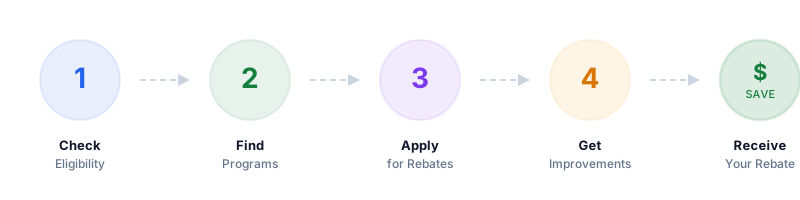
How to Claim Your Washington Rebates