How to Stack Energy Rebates: Maximize Your Savings in 2026
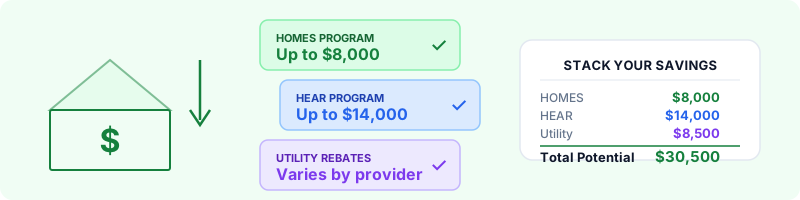
A single energy rebate can knock a few thousand dollars off your project. Stack multiple rebates together, and you might pay next to nothing. Homeowners across the country are combining federal, state, and utility incentives to cover 50% to 100% of the cost of heat pumps, insulation, electrical panels, and other upgrades.
But the stacking rules trip people up. You can't just pile every rebate on top of each other without limits. Some programs overlap. Others conflict. And a few have fine-print restrictions that could cost you thousands if you miss them.
This guide breaks down exactly which rebates you can combine in 2026, shows you real dollar amounts for common projects, and walks you through the process from start to finish.
The Four Layers of Energy Rebates
Think of energy rebates as a layer cake. Each layer comes from a different source, and most of them stack on top of each other. Here's what's available in 2026:
Layer 1: Federal HOMES Rebate
The HOMES program (Home Owner Managing Energy Savings) offers rebates for whole-home energy efficiency improvements. It's funded by the IRA with $4.3 billion and administered by each state individually.
| Income Level | Max Rebate | Cost Coverage |
|---|---|---|
| Low income (up to 80% AMI) | $8,000 | 80% of project |
| Moderate income (80-150% AMI) | $4,000 | 50% of project |
| Above 150% AMI | Not eligible | N/A |
HOMES requires demonstrated energy savings -- either modeled by software before the work starts, or measured after completion. It covers broad retrofit work: insulation, air sealing, HVAC upgrades, and more. Use our calculator to check your estimated HOMES rebate.
Layer 2: Federal HEAR Rebate
The HEAR program (Home Electrification and Appliance Rebates, also called HEEHRA) provides point-of-sale discounts on specific electrification equipment. It's funded separately from HOMES with $4.5 billion.
| Equipment | Max HEAR Rebate |
|---|---|
| Heat Pump HVAC | $8,000 |
| Electrical Panel Upgrade | $4,000 |
| Wiring Upgrade | $2,500 |
| Heat Pump Water Heater | $1,750 |
| Insulation / Weatherization | $1,600 |
| Electric Stove / Cooktop | $840 |
| Heat Pump Clothes Dryer | $840 |
Household caps: $14,000 total for low-income (up to 80% AMI), $7,000 for moderate-income (80-150% AMI). Households above 150% AMI are not eligible for HEAR.
Layer 3: State-Level Programs
Many states run their own rebate and incentive programs on top of federal ones. These vary wildly -- California's TECH Clean California offers up to $5,800 for a heat pump HVAC system, while other states may offer $500 or nothing at all. Check your state's rebate page for current programs.
Layer 4: Utility Company Rebates
Your electric or gas utility likely runs its own efficiency rebate program. These are funded by ratepayer surcharges, not tax dollars, which is why they can usually stack with everything else. For example, PG&E in California offers up to $3,200 on heat pump water heaters, and Mass Save in Massachusetts provides generous rebates on insulation and HVAC.
What About the 25C and 25D Tax Credits?
If you've been reading older guides, you might see references to the Section 25C (Energy Efficient Home Improvement Credit) and Section 25D (Residential Clean Energy Credit) tax credits. Both were terminated by the One Big Beautiful Bill (Public Law 119-21), signed July 4, 2025. They do not apply to any equipment installed in 2026 or later.
If you installed qualifying equipment before December 31, 2025, you can still claim those credits on your 2025 tax return. For details on that, see our 2025 energy tax credit filing guide. But for 2026 projects, the four layers above are what you're working with.
Stacking Rules: What You Can and Can't Combine
Here's where most homeowners get confused. Not every combination works, and the rules are different depending on which programs you're mixing.
The Golden Rule: No Double-Dipping on the Same Improvement
You cannot use both HOMES and HEAR for the same improvement. If you use HEAR to get $8,000 off a heat pump, you cannot also claim that heat pump under HOMES. One federal rebate per improvement, period.
The Stacking Cheat Sheet
| Combination | Allowed? | Notes |
|---|---|---|
| HOMES + HEAR (same improvement) | No | Pick one federal program per improvement |
| HOMES + HEAR (different improvements) | Yes | HOMES for the retrofit, HEAR for specific appliances |
| HOMES + Utility rebate | Yes | Different funding sources; usually stackable |
| HEAR + Utility rebate | Yes | Different funding sources; usually stackable |
| HOMES + State program | Usually yes | Check your state's specific rules |
| HEAR + State program | Usually yes | Check your state's specific rules |
| State + Utility | Usually yes | Some states coordinate with utilities; check locally |
| Any combo exceeding 100% of cost | No | Total incentives capped at project cost |
The 100% Cap
Almost every program includes a clause that combined incentives cannot exceed 100% of the project cost. In practice, this means if your heat pump costs $12,000 and your rebates add up to $15,000, you'll get $12,000 back -- not $15,000. You won't get a check for more than you spent.
Some states enforce this cap strictly at the point of sale. Others reconcile it during application review. Either way, plan your budget around actual costs, not theoretical maximums.
HOMES + Utility Rebates: How to Combine Them
This is one of the cleanest stacking combinations because the money comes from completely different pots. Federal HOMES funding flows through your state energy office. Utility rebates come from your electric or gas company's ratepayer-funded programs.
How It Works
- Get a home energy assessment. Many HOMES programs require a pre-retrofit energy audit, and your utility may offer free or discounted audits anyway.
- Apply for HOMES through your state's program. Submit the required documentation (income verification, contractor estimates, energy modeling).
- Apply for the utility rebate separately. Most utilities have their own application process -- often online or through your contractor.
- Complete the work. Both programs will verify completion before releasing funds.
Example: Whole-Home Retrofit in Michigan
| Rebate Source | Amount |
|---|---|
| HOMES (low-income, 30% energy savings) | $8,000 |
| DTE Energy weatherization rebate | $1,500 |
| Total savings | $9,500 |
On a $15,000 insulation and air-sealing project, that's 63% covered. The homeowner pays $5,500 out of pocket.
HEAR + Utility Rebates
HEAR rebates are designed as point-of-sale discounts, meaning the price drops at checkout. Utility rebates are typically applied for after purchase (or sometimes at the same point of sale if your contractor participates). The two stack well together.
How It Works
- Confirm your income eligibility for HEAR. Use our income eligibility guide to check your household's AMI bracket.
- Find a participating contractor or retailer. HEAR point-of-sale rebates require a participating vendor in your state.
- Get the HEAR discount at purchase. The rebate is applied before you pay.
- File for the utility rebate separately. Submit your receipt and any required documentation to your utility.
Example: Heat Pump Water Heater in Massachusetts
| Rebate Source | Amount |
|---|---|
| HEAR (low-income) | $1,750 |
| Mass Save heat pump water heater rebate | $750 |
| Total savings | $2,500 |
A typical heat pump water heater installed costs around $3,500. With $2,500 in stacked rebates, the homeowner pays $1,000.
Using HOMES and HEAR Together (Different Improvements)
This is where things get interesting -- and where the biggest savings hide. You can use both federal programs on the same project, as long as each program applies to different improvements.
The Strategy
Say you're doing a major home retrofit that includes insulation, air sealing, a new heat pump, and an electrical panel upgrade. Here's how to split it:
- HOMES covers the whole-home retrofit work: insulation, air sealing, duct sealing, and overall energy reduction.
- HEAR covers the specific appliances: the heat pump ($8,000 cap), the electrical panel ($4,000 cap), and any other qualifying equipment.
The key: the heat pump goes under HEAR. The building envelope work goes under HOMES. They're different improvements covered by different programs.
Example: Full Retrofit in Colorado
| Improvement | Cost | Program Used | Rebate |
|---|---|---|---|
| Insulation + air sealing | $8,000 | HOMES (low-income) | $6,400 (80%) |
| Heat pump HVAC | $12,000 | HEAR (low-income) | $8,000 |
| Electrical panel | $4,500 | HEAR (low-income) | $4,000 |
| Xcel Energy heat pump rebate | -- | Utility | $1,200 |
| Total project: $24,500 | $19,600 saved |
That's 80% of the project cost covered. The homeowner pays $4,900 for $24,500 worth of upgrades. And that's without adding any state-level incentives, which could push the out-of-pocket cost even lower.
Adding State Programs to the Stack
State programs are the wildcard. Some states offer thousands in additional incentives that stack on top of federal and utility rebates. Others have minimal or no extra programs. Your total savings depend heavily on where you live.
Top States for Stacking (2026)
| State | Key Program | Max Additional Incentive | Stacks with Federal? |
|---|---|---|---|
| California | TECH Clean California | $5,800 (heat pump HVAC) | Yes |
| New York | NYSERDA EmPower+ | $5,000+ (low-income) | Yes |
| Massachusetts | Mass Save + state add-ons | $10,000+ (whole-home) | Yes |
| Colorado | Energy Office programs | $3,000+ (varies) | Yes |
| Maine | Efficiency Maine | $4,000 (heat pump) | Yes |
How to Check Your State
Visit your state's rebate page on our site for a full breakdown of available programs. Each page lists active federal, state, and utility rebates with current dollar amounts and eligibility requirements.
Watch for State-Specific Caps
Some states impose their own 100% cap on combined incentives -- including federal rebates in the calculation. Others treat state and federal money separately. California, for instance, coordinates TECH Clean California with HEAR to prevent exceeding 100% of project cost, but the two programs can still stack up to that limit.
Real-World Stacking Examples
Let's walk through four common upgrade scenarios with actual dollar amounts. These assume a household at or below 80% AMI (low-income tier, which gets the highest rebates). Moderate-income households (80-150% AMI) would see roughly half these federal rebate amounts.
Scenario 1: Heat Pump Installation in California
Project cost: $15,000
| Rebate Source | Amount | Running Total |
|---|---|---|
| HEAR (heat pump HVAC, low-income) | $8,000 | $8,000 |
| TECH Clean California | $5,800 | $13,800 |
| PG&E heat pump rebate | $1,200 | $15,000 |
| Out-of-pocket cost | $0 |
Yes -- a $15,000 heat pump installation fully covered by stacking three rebate sources. This is the best-case scenario for a low-income household in California. Even at 80-150% AMI (with $4,000 HEAR instead of $8,000), the homeowner would pay just $4,000 out of pocket.
Scenario 2: Insulation + Heat Pump Water Heater in New York
Project cost: $11,000
| Improvement | Program | Rebate |
|---|---|---|
| Insulation ($7,000) | HOMES (low-income, 35% energy savings) | $5,600 |
| HP water heater ($4,000) | HEAR (low-income) | $1,750 |
| HP water heater | NYSERDA | $1,000 |
| Insulation | Con Edison | $800 |
| Total rebates | $9,150 | |
| Out-of-pocket cost | $1,850 |
Notice how HOMES covers the insulation and HEAR covers the water heater -- different programs for different improvements, both federal, both on the same project.
Scenario 3: Electrical Panel + Electric Stove in Georgia
Project cost: $6,500
| Improvement | Program | Rebate |
|---|---|---|
| Electrical panel ($5,200) | HEAR (low-income) | $4,000 |
| Electric stove ($1,300) | HEAR (low-income) | $840 |
| Panel upgrade | Georgia Power | $500 |
| Total rebates | $5,340 | |
| Out-of-pocket cost | $1,160 |
Both appliances go under HEAR since they're equipment-specific rebates. Georgia Power's utility rebate stacks on top. Georgia's HEAR program is already live, making this a project you could start tomorrow.
Scenario 4: Full Deep Energy Retrofit in Massachusetts
Project cost: $38,000
| Improvement | Program | Rebate |
|---|---|---|
| Envelope work: insulation, air sealing, windows ($18,000) | HOMES (low-income) | $8,000 |
| Heat pump HVAC ($14,000) | HEAR (low-income) | $8,000 |
| Electrical panel ($5,000) | HEAR (low-income) | $4,000 |
| Electric stove ($1,000) | HEAR (low-income cap reached) | $0* |
| Whole-home | Mass Save | $4,000 |
| Heat pump | Mass Save add-on | $1,250 |
| Total rebates | $25,250 | |
| Out-of-pocket cost | $12,750 |
*The HEAR household cap is $14,000 for low-income. The heat pump ($8,000) + panel ($4,000) already uses $12,000 of that cap, leaving only $2,000. The stove's $840 fits, bringing the HEAR total to $12,840. Updated rebate: electric stove HEAR = $840. Total rebates = $26,090. Out-of-pocket = $11,910.
Even on a large $38,000 project, stacking gets you over 68% savings. That's the power of combining HOMES (for envelope work) with HEAR (for appliances) plus utility incentives.
Step-by-Step: How to Stack Your Rebates
Ready to do this yourself? Follow these eight steps in order. Skipping ahead or applying to programs in the wrong sequence is one of the most common reasons people leave money on the table.
Step 1: Determine Your Income Bracket
Both HOMES and HEAR use Area Median Income (AMI) to set rebate tiers. You need to know whether your household falls below 80% AMI (low-income), between 80-150% AMI (moderate-income), or above 150% AMI (not eligible for federal rebates). Use our income eligibility guide to find your AMI bracket based on your zip code and household size.
Step 2: List Every Improvement You Want
Write down everything: heat pump, insulation, electrical panel, water heater, stove -- all of it. This full list is what you'll use to decide which program covers which improvement.
Step 3: Check Your State's Program Status
Not all states have launched their HOMES and HEAR programs yet. Visit your state's page on our site to see which programs are currently accepting applications. If your state hasn't launched yet, you may want to wait -- or proceed with utility and state incentives only.
Step 4: Assign Each Improvement to a Program
This is the strategic part. For each improvement, decide whether HOMES or HEAR gives you the better deal:
- Whole-home envelope work (insulation, air sealing, duct work) usually goes under HOMES because HEAR doesn't cover general retrofit work as effectively.
- Specific appliances (heat pumps, panels, stoves, water heaters) usually go under HEAR because the per-item caps are generous.
- Check whether any improvement qualifies for a higher rebate under a state program instead.
Step 5: Get a Home Energy Assessment
If you're using HOMES, most state programs require an energy assessment (audit) before the work begins. Some utilities offer these for free. This assessment establishes your baseline energy use and projects the savings from proposed improvements.
Step 6: Apply for Federal Programs First
Start with HOMES and HEAR applications through your state's energy office. Federal rebates are the largest amounts, and some state programs adjust their own rebates based on what federal money you've secured.
Step 7: Apply for State and Utility Programs
Once you know your federal rebate amounts, apply for state programs and utility rebates. Some of these can be applied for simultaneously; others require proof of the federal application. Your contractor often handles utility rebate paperwork.
Step 8: Complete the Work and Collect
Hire a qualified contractor (BPI-certified for HOMES, participating retailer for HEAR point-of-sale discounts). Keep every receipt and document. HEAR discounts apply at purchase; HOMES and utility rebates may arrive weeks or months after project completion.
Common Stacking Mistakes to Avoid
After reviewing hundreds of rebate applications and talking with homeowners who've been through the process, these are the mistakes that come up again and again.
Mistake 1: Claiming HOMES and HEAR for the Same Heat Pump
This is the number one error. Your new heat pump goes under either HOMES or HEAR -- not both. In almost every case, HEAR is the better choice for the heat pump itself (up to $8,000 for low-income), while HOMES covers the surrounding retrofit work (insulation, air sealing).
Mistake 2: Assuming 25C and 25D Still Exist
If your contractor or a website tells you to "claim the 30% tax credit" or "take the $3,200 annual credit" for 2026 installations -- that's outdated information. The One Big Beautiful Bill killed both 25C and 25D for equipment installed after December 31, 2025. The only people who can still claim those credits installed their equipment in 2025 or earlier.
Mistake 3: Forgetting the 100% Cap
When your rebates stack up to more than the project cost, the excess gets clawed back. Plan your project budget first, then figure out which combination of rebates gets you closest to -- but not over -- 100% coverage. Going over doesn't help you; it just means one of the rebates gets reduced.
Mistake 4: Not Checking if Your State's Program Is Live
As of February 2026, only a handful of states have fully launched both HOMES and HEAR. States with live HEAR programs include AZ, CA, CO, GA, ME, MI, NM, NC, NY, RI, DC, and WI. HOMES is live in fewer states: GA, MI, NC, DC, and WI. If your state hasn't launched yet, don't delay useful utility rebates while waiting.
Mistake 5: Starting Work Before Applying
Some programs require pre-approval. If you install a heat pump and then apply for HOMES, your state may reject the application because no pre-retrofit energy assessment was done. Always apply and get confirmation before your contractor starts work.
Mistake 6: Ignoring Utility Rebates
Homeowners often focus on the big federal numbers and forget that utility rebates are some of the easiest money to claim. Many utilities offer $500 to $3,200 per improvement with simple online applications. These stack with everything else and have fewer restrictions. Check your utility's rebate page -- you might be surprised what's available.
Mistake 7: Hiring a Non-Participating Contractor
HEAR point-of-sale rebates require a participating retailer or contractor. HOMES may require BPI-certified professionals. If your contractor isn't enrolled in the program, you won't get the rebate -- even if the work qualifies. Verify participation before signing any contracts.
Mistake 8: Not Keeping Documentation
Save everything: invoices, receipts, contractor certifications, energy audit reports, rebate confirmation emails, and before/after photos. You may need these for state audits, utility verification, or if a rebate payment is delayed or disputed. A $20 folder could protect $20,000 in rebates.
Calculate Your Stacked Rebates
Enter your zip code, income, and planned improvements to see exactly which rebates you can combine and how much you'll save.
Ready to Start? Find Pre-Screened Installers Near You
Get free, no-obligation quotes from certified local contractors for heat pumps, solar, and insulation — and see your total after rebates.
Free quotes · No commitment · Certified local contractors