Energy Tax Credits 2025: How to Claim 25C & 25D Before They're Gone
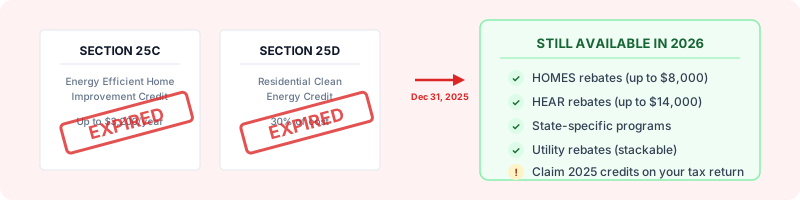
If you made energy-efficient upgrades to your home in 2025, you are still owed money by the federal government. The energy efficient home improvement credit (Section 25C) and the residential clean energy credit (Section 25D) both expired on December 31, 2025 — killed by the One Big Beautiful Bill. But here is the thing most people miss: you can still claim every dollar you are owed on your 2025 tax return, which you file in 2026.
This guide breaks down both credits, what qualified, how much you can get back, and exactly how to file. If you installed a heat pump, added insulation, put up solar panels, or made any other qualifying improvement last year, keep reading. You have money sitting on the table.
The 25C Energy Efficient Home Improvement Credit
Section 25C — officially the Energy Efficient Home Improvement Credit — gave homeowners a tax credit for specific efficiency upgrades. It covered the bread-and-butter stuff: insulation, windows, doors, heat pumps, central AC, water heaters, and home energy audits.
The credit worked on a calendar-year basis. Each year, you could claim up to $3,200 total, broken into two buckets:
- $1,200 general limit — covered insulation, windows, doors, skylights, electrical panels, and energy audits
- $2,000 heat pump bonus — covered heat pump HVAC systems, heat pump water heaters, and biomass stoves
These two buckets stacked. So if you installed a heat pump ($2,000 credit) and added insulation ($1,200 credit) in the same year, you could claim the full $3,200.
A few things to know about how 25C worked:
- Non-refundable credit. It reduced your tax bill dollar-for-dollar but would not generate a refund. If you owed $2,000 in taxes and had a $3,200 credit, you would pay $0 — but you would not get the remaining $1,200 back.
- Annual reset. The $3,200 cap reset every tax year. Someone who upgraded windows in 2024 and installed a heat pump in 2025 could claim credits for both years.
- Primary residence only. Rental properties, second homes, and new construction did not qualify.
- Products had to meet efficiency standards. Not every heat pump or window qualified — they needed to meet specific ENERGY STAR or CEE tier requirements.
What Qualified Under 25C
The 25C credit covered a specific list of improvements, each with its own dollar cap. Here is the full breakdown of what qualified and how much each was worth:
| Improvement | Credit Amount | Cap Category | Efficiency Requirement |
|---|---|---|---|
| Heat pump (HVAC) | 30% of cost, up to $2,000 | Heat pump bonus ($2,000) | CEE Tier or ENERGY STAR Most Efficient |
| Heat pump water heater | 30% of cost, up to $2,000 | Heat pump bonus ($2,000) | ENERGY STAR certified |
| Biomass stove/boiler | 30% of cost, up to $2,000 | Heat pump bonus ($2,000) | 75% thermal efficiency |
| Insulation & air sealing | 30% of cost, up to $1,200 | General ($1,200) | Meets IECC standards |
| Exterior windows & skylights | 30% of cost, up to $600 | General ($1,200) | ENERGY STAR Most Efficient |
| Exterior doors | 30% of cost, up to $500 ($250/door) | General ($1,200) | ENERGY STAR certified |
| Central AC | 30% of cost, up to $600 | General ($1,200) | ENERGY STAR Most Efficient or CEE Tier |
| Natural gas furnace/boiler | 30% of cost, up to $600 | General ($1,200) | AFUE ≥ 97% |
| Electrical panel upgrade | 30% of cost, up to $600 | General ($1,200) | 200-amp service panel for electrification |
| Home energy audit | 30% of cost, up to $150 | General ($1,200) | DOE-certified auditor |
One common mistake: people confuse the individual item caps with the overall cap. The $600 window limit and the $500 door limit both count toward the $1,200 general bucket. You could not claim $600 for windows and $600 for an AC unit and $600 for an electrical panel — the general bucket maxes out at $1,200 total regardless of how many qualifying items you bought.
The $2,000 heat pump bonus was separate. A homeowner who installed a heat pump water heater for $3,500 could claim $1,050 (30% of cost, under the $2,000 cap) plus still use the full $1,200 general limit for other improvements.
The 25D Residential Clean Energy Credit
Section 25D — the Residential Clean Energy Credit — was the bigger, uncapped sibling of 25C. While 25C focused on efficiency upgrades, 25D covered clean energy generation systems: solar panels, geothermal heat pumps, battery storage, wind turbines, and fuel cells.
The headline number: 30% of the total installed cost, with no annual dollar cap.
That is not a typo. A $30,000 rooftop solar installation qualified for a $9,000 tax credit. A $50,000 solar-plus-battery system was worth $15,000 back. There was no ceiling — the 30% rate applied to every dollar spent on qualifying equipment and installation labor.
Key details about the 25D credit:
- Non-refundable, same as 25C. The credit reduced your tax liability but did not generate a refund on its own.
- Carryforward allowed. Unlike 25C, if your 25D credit exceeded your tax bill, you could carry the unused portion forward to future tax years. This was a major benefit for large solar or geothermal installations where the credit often exceeded a single year's tax liability.
- Primary and secondary residences. 25D applied to your main home and vacation homes. Rental properties were excluded.
- Labor costs included. The 30% applied to equipment, installation labor, and related materials — the full project cost.
What Qualified Under 25D
The 25D credit covered clean energy systems installed at your residence. Every item received the same 30% rate with no individual caps:
| Clean Energy System | Credit Rate | Annual Cap | Key Requirements |
|---|---|---|---|
| Solar photovoltaic (PV) panels | 30% of cost | No cap | New equipment, generates electricity for your home |
| Solar water heating systems | 30% of cost | No cap | SRCC certified, at least 50% of home water heating |
| Battery storage systems | 30% of cost | No cap | Capacity ≥ 3 kWh |
| Small wind turbines | 30% of cost | No cap | Generates electricity at residence |
| Geothermal heat pumps | 30% of cost | No cap | ENERGY STAR certified |
| Fuel cells | 30% of cost | $500 per 0.5 kW capacity | Fuel cell efficiency ≥ 30% |
A practical example: a household that installed a $25,000 solar PV system plus a $12,000 battery storage unit in 2025 would qualify for a $11,100 credit (30% of $37,000). If their total federal tax liability for 2025 is $7,000, they would pay $0 in tax and carry the remaining $4,100 forward to 2026.
That carryforward is where things get interesting — and complicated — now that the credit has expired. More on that below.
How to Claim These Credits on Your 2025 Tax Return
You file for both 25C and 25D using IRS Form 5695, Residential Energy Credits. The form has two parts, one for each credit. Here is the step-by-step process:
Step 1: Gather Your Documentation
Before you sit down with the form, collect these items:
- Receipts and invoices for every qualifying improvement (equipment cost + installation labor)
- Manufacturer certification statements — the manufacturer or retailer should provide a written statement that the product meets IRS efficiency requirements
- Proof of installation date — the equipment must have been “placed in service” (installed and operational) between January 1, 2025 and December 31, 2025
- Energy audit report (if claiming the $150 audit credit) from a DOE-certified home energy auditor
Step 2: Complete Form 5695 Part II (25C)
If you are claiming the energy efficient home improvement credit:
- Enter the cost of each qualifying improvement in the appropriate line (Lines 16–23 cover different improvement types)
- Apply the 30% rate to each line item
- Observe the per-item caps ($600 for windows, $500 for doors, etc.)
- Total your credits, respecting the $1,200 general limit and $2,000 heat pump bonus limit
- Transfer the total to Line 30
Step 3: Complete Form 5695 Part I (25D)
If you are claiming the residential clean energy credit:
- Enter the total cost of each qualifying clean energy system (Lines 1–6)
- Multiply each total by 30%
- Add the results on Line 13
- If you have carryforward credits from prior years, add those on Line 16
- Your total 25D credit goes on Line 15
Step 4: Calculate Your Tax Limitation
Both credits are non-refundable, so Form 5695 walks you through comparing your total credit to your actual tax liability. The form references your tax from Form 1040 and subtracts other non-refundable credits you have already claimed. The result is the maximum credit you can actually use this year.
Step 5: Transfer to Form 1040
Your final credit amount from Form 5695 transfers to Schedule 3 (Form 1040), Line 5. This flows through to your Form 1040 and directly reduces your tax owed.
Filing deadline: Your 2025 federal tax return is due April 15, 2026. If you file an extension, you have until October 15, 2026 — but the credit is not going anywhere, so there is no rush beyond normal filing deadlines. Just do not skip it.
If you use tax software like TurboTax, H&R Block, or FreeTaxUSA, the program will handle Form 5695 for you. Look for sections labeled “energy credits,” “home improvements,” or “residential energy.” Answer the prompts and the software fills in the form.
Why These Credits Expired: The OBBB
The One Big Beautiful Bill (Public Law 119-21), signed by President Trump on July 4, 2025, terminated both the 25C and 25D credits for property placed in service after December 31, 2025.
Some background: both credits were created (or dramatically expanded) by the Inflation Reduction Act of 2022. The IRA originally set 25C to run through 2032 and 25D through 2034, with the 25D rate stepping down from 30% to 26% in 2033 and 22% in 2034. Homeowners had years of runway — or so they thought.
The OBBB changed that. As part of a broader package of tax reforms, the bill repealed both credits effective for any property placed in service after the end of 2025. The repeal was not retroactive — anything installed in 2025 or earlier still qualifies — but nothing installed from January 1, 2026 onward is eligible for 25C or 25D.
For homeowners, the practical impact is straightforward:
- If your heat pump, solar panels, or other improvements were installed and working by December 31, 2025 — you can claim the credit
- If installation was completed on or after January 1, 2026 — no federal tax credit is available through 25C or 25D
- The “placed in service” date is when the system is installed, tested, and operational — not when you signed the contract or made a deposit
The timing cutoff has been a point of frustration for homeowners who signed contracts in 2025 but had installations delayed into 2026. Unfortunately, the statute is clear: the placed-in-service date is what matters. If your contractor finished the job on January 2, 2026, the credits do not apply.
Can You Carry Forward Unused Credits?
This is one of the most common questions — and the answer depends entirely on which credit you are talking about.
25C: No Carryforward
The energy efficient home improvement credit (25C) has never allowed carryforward. If your 25C credit exceeds your tax liability in a given year, the excess is lost. Period.
Example: You owed $1,500 in federal taxes for 2025 and claimed a $3,200 credit under 25C. Your tax bill drops to $0, but the remaining $1,700 disappears. You cannot carry it to 2026 or any future year.
This is why tax advisors often recommended timing 25C improvements strategically — spreading upgrades across multiple tax years to fully use each year's credit against your tax liability.
25D: Carryforward Was Allowed (But It Is Complicated Now)
The residential clean energy credit (25D) did allow unused credits to carry forward to subsequent tax years. This was a critical feature for expensive installations like solar panel systems, where the credit often exceeded a homeowner's annual tax bill.
If you have unused 25D credits from 2024 or 2025, those credits should still carry forward to 2026 and beyond. The OBBB terminated the credit for new installations, but did not explicitly eliminate the carryforward provision for credits already earned.
That said, this is genuinely complex territory. The IRS has not yet issued detailed guidance on how 25D carryforwards interact with the post-OBBB landscape. If you have significant unused 25D credits, consult a tax professional. The stakes are too high for guesswork.
A few scenarios to consider:
- Large solar install in 2025, credit exceeds 2025 tax: Carry the excess to your 2026 return. You will likely need to file Form 5695 again in 2026 to claim the carryforward amount, even though you are not taking a new credit.
- Unused carryforward from 2024: Claim it on your 2025 return. Any remaining excess should carry to 2026.
- Unclear how long carryforward lasts: The original statute allowed carryforward until the credit phased out (2034 was the original sunset). With the OBBB termination, the duration of the carryforward period is an open legal question. Get professional advice.
What Replaced These Credits in 2026?
The 25C and 25D tax credits are gone for new installations. But federal energy incentives did not disappear entirely. Two IRA-funded programs survived the OBBB and continue operating in 2026:
HOMES Rebate Program
The Home Owner Managing Energy Savings (HOMES) program provides rebates for whole-home energy efficiency improvements. Key differences from the old tax credits:
- Direct rebate, not a tax credit. HOMES rebates reduce your upfront cost or reimburse you directly. No need to wait for tax season.
- Income-based. Households at or below 80% of area median income (AMI) can receive up to $8,000. Households at 80–150% AMI can get up to $4,000. Above 150% AMI? Not eligible.
- Performance-based. Your rebate amount depends on how much energy your improvements actually save, measured or modeled.
- State-administered. Each state runs its own version of the program. Not all states are live yet. Check your state's status here.
HEAR Rebate Program (HEEHRA)
The Home Electrification and Appliance Rebates (HEAR) program provides point-of-sale rebates for specific electrification equipment:
| Equipment | Max HEAR Rebate |
|---|---|
| Heat pump HVAC | $8,000 |
| Electrical panel upgrade | $4,000 |
| Wiring upgrade | $2,500 |
| Heat pump water heater | $1,750 |
| Insulation & weatherization | $1,600 |
| Electric stove/cooktop | $840 |
| Electric dryer | $840 |
HEAR income limits: households at or below 80% AMI can receive up to $14,000 total across all appliances. Households at 80–150% AMI get up to $7,000. Above 150% AMI is not eligible for HEAR.
Utility and State Rebates
Beyond the two federal programs, many state governments and utility companies continue offering their own efficiency rebates. These are independent of the OBBB and vary widely by location. Some examples:
- California offers additional state-funded incentives through TECH Clean California and SGIP (battery storage)
- New York runs EmPower+ and the Residential Clean Heating and Cooling program
- Massachusetts has Mass Save, one of the most generous utility rebate programs in the country
- Colorado provides state tax credits for certain energy improvements on top of federal programs
The bottom line: if you made qualifying improvements in 2025, file your taxes and claim what you are owed. It is free money that a lot of homeowners leave on the table. And if you are planning improvements in 2026, the rebate calculator on our homepage will show you exactly what programs are available in your area.
Ready to Start? Find Pre-Screened Installers Near You
Get free, no-obligation quotes from certified local contractors for heat pumps, solar, and insulation — and see your total after rebates.
Free quotes · No commitment · Certified local contractors