How to Claim Your 2025 Energy Tax Credits Before They're Gone
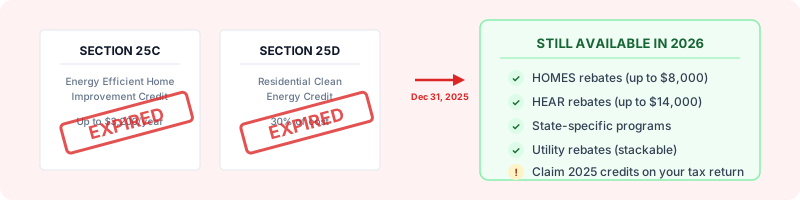
The energy tax credits are gone for 2026 work. But here's what a lot of homeowners are missing: if you installed a heat pump, added insulation, replaced windows, put up solar panels, or made other qualifying upgrades before December 31, 2025, you have a legitimate federal tax credit waiting to be claimed. The One Big Beautiful Bill terminated these credits going forward — it didn't erase credits earned for work done in 2025.
April 15, 2026 is your filing deadline. If you completed qualifying work last year and haven't filed yet, this is real money. If you've already filed without claiming the credit, an amended return is an option. Either way, the first step is understanding exactly what you can claim and what the IRS needs to see.
The Two Credits You're Working With
Two separate credits apply to 2025 residential energy improvements, and they work differently. You might qualify for one, the other, or both.
Section 25C — Nonbusiness Energy Property Credit
This covers the most common home efficiency upgrades: heat pumps for heating and cooling, heat pump water heaters, insulation and air sealing, exterior windows and skylights, exterior doors, and professional home energy audits. The credit is worth 30% of costs, but it's capped. Heat pumps and heat pump water heaters share a $2,000 annual cap. Everything else — insulation, windows, doors, audits — shares a separate $1,200 annual cap. You can reach both caps in the same year, so the theoretical maximum from 25C alone is $3,200 for a single tax year.
Section 25D — Residential Clean Energy Credit
This covers solar photovoltaic systems, battery storage systems of 3 kWh or more, geothermal heat pumps, and small residential wind turbines. The credit is 30% with no upper cap. A $25,000 solar installation generates $7,500 in federal tax credit. If your tax liability doesn't absorb the full credit in 2025, the unused portion can carry forward to your 2026 return — the carryforward provision survived even though the credit itself didn't renew for new 2026 work.
| Upgrade Type | Credit | Rate | Annual Cap |
|---|---|---|---|
| Heat pump (HVAC) | 25C | 30% | $2,000 |
| Heat pump water heater | 25C | 30% | $2,000 (shared with heat pump) |
| Insulation / air sealing | 25C | 30% | $1,200 |
| Exterior windows / skylights | 25C | 30% | $600 (within $1,200 cap) |
| Exterior doors | 25C | 30% | $250/door, $500 total (within $1,200 cap) |
| Home energy audit | 25C | 30% | $150 (within $1,200 cap) |
| Solar panels (PV) | 25D | 30% | No cap |
| Battery storage (3+ kWh) | 25D | 30% | No cap |
| Geothermal heat pump | 25D | 30% | No cap |
IRS Form 5695: The Form That Actually Matters
Both 25C and 25D are claimed on IRS Form 5695, "Residential Energy Credits." This is a one-page form that calculates your total credit and carries the result to Schedule 3, which feeds into your main Form 1040.
Part I of Form 5695 handles the 25D credit (solar, battery, geothermal). Part II handles 25C (equipment and efficiency upgrades). If you have both, you complete both parts and add them together.
The math on the form is straightforward — you're entering your qualified costs, and the form calculates 30% and checks against the applicable caps. What trips people up isn't the arithmetic; it's not having the right documentation to support the numbers they enter.
Documentation You Need Before You File
The IRS doesn't require you to attach most supporting documents to your return, but you need to have them available if you're ever audited. Collecting them now, before you file, is much easier than hunting them down later.
For 25C (equipment credits):
- Manufacturer's certification statement confirming the product meets the efficiency requirements for the credit. This is typically available on the manufacturer's website or can be requested from the installer. Heat pumps must meet specific SEER2 and HSPF2 ratings; insulation must meet IECC standards for your climate zone.
- Itemized receipts or invoices that split equipment from installation labor. The split matters because the IRS treats the two families differently: for heat pumps and heat pump water heaters, installation labor counts toward the credit; for insulation, windows and doors (the "building envelope"), it doesn't.
- Proof that the property is your primary residence (your address matches your tax filing address).
For 25D (solar and clean energy credits):
- Signed installation contract and final invoice showing total system cost.
- Proof of when installation was completed, such as the installer's completion certificate, the final inspection sign-off or your utility's interconnection approval (Permission to Operate). The completion date is what ties the credit to your 2025 return.
- For battery storage: documentation that the system capacity is at least 3 kWh.
- Loan documents if the system was financed — you can still claim the credit on the full cost, not just the down payment.
One clarification on timing: the IRS guidance on 25D says you claim the credit for the tax year the property is installed, not merely purchased, and that it isn't available for property placed in service after December 31, 2025. A contract signed or a deposit paid in 2025 doesn't count on its own. The awkward case is a system physically finished in late 2025 whose utility approval only came through in January 2026: the IRS page doesn't spell that one out, so put it in front of a tax professional rather than guessing either way.
Common Mistakes That Get Claims Denied
Mixing up which labor counts under 25C. People get this backwards in both directions. For a heat pump or heat pump water heater, the IRS lets installation labor into the cost basis, so leaving it out shrinks your credit for nothing (the $2,000 cap still applies). For insulation, windows and exterior doors it's the opposite: the IRS is explicit that labor to install building envelope components doesn't qualify. An invoice that lumps everything into one number makes both mistakes easier, so ask your installer to itemize.
Missing the efficiency threshold for heat pumps. Not every heat pump qualifies. For the $2,000 25C credit, the equipment must meet or exceed the highest Consortium for Energy Efficiency (CEE) tier, not counting any "advanced" tier, in effect at the start of the year it was installed. If your installer put in a standard-efficiency unit rather than a qualifying model, you might not be eligible. Check the manufacturer's certification statement — this is non-negotiable.
Applying the credit to the wrong property. The two credits draw the line in different places. 25C is for improvements to your main home, so a vacation house is out. 25D is looser: the IRS allows it for a second home in the U.S. that you live in part-time and don't rent out (fuel cells excepted). A property you rent to others doesn't qualify for either.
Thinking you can claim 2026 work by prepaying in 2025. The credit is based on when the work was completed and placed in service, not when you paid. Writing a check in December 2025 for work done in February 2026 doesn't make the credit claimable on your 2025 return.
Not claiming the carryforward from prior years. If you had unused 25D credit from 2023 or 2024 that you carried forward, make sure you're picking it up on your 2025 return. The carryforward amount from prior years appears in Part I of Form 5695.
What If You Already Filed Without Claiming the Credit?
File Form 1040-X, Amended U.S. Individual Income Tax Return. Attach a corrected Form 5695 with your amended return. The IRS allows amendments within three years of the original filing deadline, so you have time — but there's no reason to wait since the refund or reduced tax liability is money you're owed.
Tax software handles this fairly cleanly if you used software to file originally. If you used a preparer, call them and let them know you need an amended return to claim missed energy credits — most preparers will handle this for a modest fee and it's typically worth it given the credit amounts involved.
Heat Pumps: The Largest Single Opportunity
For most homeowners, the heat pump credit represents the largest single 25C opportunity. The $2,000 cap applies to the combined total of qualifying heat pumps for space conditioning and heat pump water heaters. If you installed both in 2025, the combined credit maxes out at $2,000 — not $4,000. Plan your documentation accordingly.
If you're doing a heat pump project now in 2026, you can't get 25C anymore. The HEAR program is the path worth exploring instead, with two caveats: it's for income-eligible households, and it only exists where your state has actually launched its program (the Department of Energy lists it as available in select states). Our HEAR guide keeps the current caps and state status. The heat pump rebate calculator shows current HEAR amounts by state.
Solar Credits: The 30% With No Cap
If you had a solar system placed in service in 2025, 25D is potentially the most valuable thing on your tax return. At 30% of total system cost with no cap, a mid-sized residential system can generate $6,000–$12,000 in credit depending on your location and system size. The solar rebate calculator can give you a rough estimate of your 2025 system value if you want to sanity-check the numbers before filing. For the Form 5695 side (which lines carry the solar cost, the credit allowed and the carryforward to 2026, and why used panels don't qualify), see our walkthrough of the solar credit on Form 5695.
Remember that 25D is a nonrefundable credit — it can reduce your tax liability to zero but won't generate a refund on its own. Any amount that exceeds your 2025 tax liability carries forward to your 2026 return. So if you owe $5,000 in federal taxes for 2025 and your 25D credit is $9,000, you apply $5,000 to wipe out your 2025 liability and carry $4,000 to 2026.
The April 15 Deadline — And Extensions
April 15, 2026 is the filing deadline for 2025 federal returns. If you need more time, you can file for an automatic six-month extension (Form 4868), which pushes the filing deadline to October 15, 2026. But an extension to file is not an extension to pay — if you owe taxes, that payment is still due April 15.
There's no strategic reason to delay claiming energy credits by filing late. The credits don't change based on when you file. File as soon as you have your documentation together.
What's Available for 2026 Projects
If you're planning a project now in 2026, the tax credit path is closed. The OBBB eliminated 25C and 25D for tax year 2026 and beyond. What replaced them are the federal rebate programs:
The HOMES program pays rebates based on modeled whole-home energy savings, with a 20% savings minimum and up to $8,000 per household according to the Department of Energy; states can raise the amount for lower-income households. The HEAR program gives point-of-sale discounts on qualifying equipment to income-eligible households. Neither needs a tax bill to absorb it, since they're rebates rather than credits, and both depend on your state having launched them.
The state rebates index covers what's available by state, and the stacking rebates guide shows how to layer federal, state, and utility programs together on a single project. And the OBBB energy changes guide gives a full picture of what changed and what remains.
For 2025 work: file, claim what you earned, and document everything. For 2026 work: the rebate programs are the path forward. Use the rebate calculator to see what's actually available in your state for your specific upgrade.
Ready to Start? Find Pre-Screened Installers Near You
Get free, no-obligation quotes from certified local contractors for heat pumps, solar, and insulation — and see your total after rebates.
Free quotes · No commitment · Certified local contractors