One Big Beautiful Bill (OBBB): How It Changed Energy Rebates in 2026
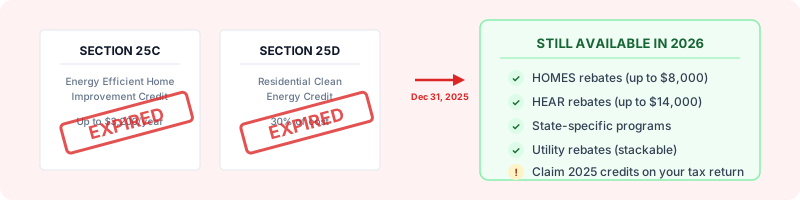
The energy incentive landscape changed dramatically in 2025, and the consequences are playing out for homeowners in 2026. A single piece of legislation — the One Big Beautiful Bill, signed on July 4, 2025 — ended two of the most valuable residential energy tax credits ever enacted. At the same time, a White House executive order temporarily froze billions in rebate funding before federal courts stepped in.
If you're trying to understand what federal energy incentives still exist, what's gone, and what you should do about it — this is the guide that sorts it all out. Use our rebate calculator to see what programs are currently available in your state.
What Is the One Big Beautiful Bill?
The One Big Beautiful Bill (officially Public Law 119-21) is a fiscal reconciliation package signed by President Trump on July 4, 2025. It extended the individual and business tax cuts from the 2017 Tax Cuts and Jobs Act, which were set to expire at the end of 2025. The bill also made a range of spending and revenue changes, including significant modifications to energy tax policy.
Reconciliation bills have special procedural rules that allow them to pass the Senate with a simple majority (51 votes) rather than the usual 60 needed to overcome a filibuster. This is the same process used to pass the 2022 Inflation Reduction Act that created the HOMES and HEAR programs. The OBBB used the same process to undo parts of the IRA's tax provisions.
At over 1,000 pages, the OBBB covered dozens of policy areas. The energy tax credit changes, while significant for homeowners, were a small fraction of the bill's total scope.
What the OBBB Terminated: 25C and 25D Credits
The OBBB terminated two specific IRA energy tax credits, with a hard cutoff of December 31, 2025. Any property placed in service on or after January 1, 2026 is ineligible.
Section 25C: Energy Efficient Home Improvement Credit
The 25C credit gave homeowners up to $3,200 per year for qualifying energy efficiency improvements. It covered:
| Improvement | Annual Credit Limit | Credit Rate |
|---|---|---|
| Heat pumps (HVAC) | $2,000 | 30% |
| Heat pump water heaters | $2,000 | 30% |
| Insulation | $1,200 | 30% |
| Windows (per year) | $600 | 30% |
| Doors (per year) | $500 per door, $250 max | 30% |
| Energy audit | $150 | 30% |
| Electrical panel upgrade | $600 | 30% |
| Annual maximum (total) | $3,200 |
The 25C credit had no income limit — a household earning $500,000 qualified just as a household earning $50,000 did. It was also a tax credit (not a deduction), meaning it reduced your tax bill dollar-for-dollar. For homeowners in high tax brackets making large energy efficiency investments, this was significant money.
The OBBB terminated 25C for property placed in service after December 31, 2025. Any qualifying improvement installed before that date can still be claimed on the 2025 tax return using Form 5695.
Section 25D: Residential Clean Energy Credit
The 25D credit was even more powerful — 30% of the total cost of solar panels, battery storage, geothermal heat pumps, small wind turbines, and fuel cells, with no annual dollar cap and no income limit.
| Technology | Credit | Example: $20,000 System |
|---|---|---|
| Solar panels | 30% of cost | $6,000 |
| Battery storage (≥3 kWh) | 30% of cost | $6,000 (on $20k battery) |
| Geothermal heat pump | 30% of cost | $6,000 |
| Small wind turbine | 30% of cost | $6,000 |
Like 25C, the OBBB terminated 25D for property placed in service after December 31, 2025. If you had solar installed before that date, claim it on your 2025 return. Our 25D credit guide covers the carryforward rules and filing deadlines in detail.
What Survived: HOMES and HEAR Programs
The OBBB specifically targeted the tax code provisions of the IRA. The HOMES and HEAR programs operate through a different mechanism — direct federal appropriations administered by state energy offices — and the OBBB did not rescind those appropriations.
Why They Survived
Tax credits (25C and 25D) are embedded in the Internal Revenue Code. Changing them requires tax legislation — which is exactly what the OBBB did through reconciliation. But HOMES and HEAR funding is appropriated money sitting in the Department of Energy's accounts. Rescinding appropriations requires a separate legislative act called a rescission, which the OBBB did not include for these programs.
This distinction matters. The OBBB authors chose to terminate the tax credits but leave the direct rebate programs intact. The political calculation appears to have been that the rebate programs — which are income-limited and primarily benefit lower- and moderate-income households — were harder to eliminate than the tax credits, which benefited all income levels.
Current Status of HOMES and HEAR
| Program | Federal Budget | Status | Max Benefit |
|---|---|---|---|
| HOMES | $4.3 billion | Active — states administering | $8,000 (low income) |
| HEAR | $4.5 billion | Active — states administering | $14,000 (low income) |
As of February 2026, more than 20 states have live HOMES or HEAR programs accepting applications. Funding is first-come, first-served within each state's allocation. The programs run until funds are depleted or September 30, 2031, whichever comes first.
EO 14154 and the IRA Funding Freeze
The OBBB wasn't the only policy shock to the energy rebate landscape in 2025. On January 20, 2025 — Inauguration Day — President Trump signed Executive Order 14154, which among other things ordered a pause on the disbursement of IRA and Infrastructure Investment and Jobs Act funds.
What Happened
- January 20, 2025: EO 14154 signed, ordering review and potential pause of IRA spending.
- January 27, 2025: Office of Management and Budget issued guidance pausing federal grant disbursements across multiple programs, including those funding HOMES and HEAR state programs.
- January 28-29, 2025: Federal district court issued a temporary restraining order blocking the freeze for programs beyond those specifically listed in the EO.
- February-March 2025: Multiple federal courts reinforced that appropriated IRA funds could not be withheld without Congressional action.
- May 2025: DOE resumed normal processing of HOMES and HEAR state program disbursements.
- July 4, 2025: OBBB signed, terminating 25C and 25D tax credits with no effect on HOMES and HEAR.
The practical impact on homeowners varied by state. States that had already received their initial IRA funding and were operating programs experienced minimal disruption. States still in the contracting and setup phase faced delays of several months. By the fall of 2025, the disruption had largely resolved and programs were operating normally.
Timeline of Changes: 2025-2026
| Date | Event | Impact on Homeowners |
|---|---|---|
| January 20, 2025 | EO 14154 signed, IRA freeze ordered | Uncertainty; some state programs paused |
| January 28, 2025 | Court orders block freeze | Programs gradually resume |
| May 2025 | DOE resumes normal HOMES/HEAR disbursements | State programs reopen/accelerate |
| July 4, 2025 | OBBB signed (Public Law 119-21) | 25C and 25D terminated after Dec 31, 2025 |
| December 31, 2025 | 25C and 25D expiration effective | Tax credits unavailable for 2026 work |
| April 15, 2026 | 2025 tax return filing deadline | Last standard deadline to claim 2025 work |
| October 15, 2026 | Extended filing deadline | Extended deadline for 2025 25C/25D claims |
| September 30, 2031 | HOMES/HEAR program end date | Federal funding expires (or sooner if depleted) |
How the Changes Affect Common Home Projects
Heat Pump Installation
Before OBBB: Could claim up to $2,000 25C credit (30% of cost, no income limit) plus HEAR rebate up to $8,000 (income-limited).
After OBBB (2026): HEAR rebate up to $8,000 (income-limited) only. No 25C credit.
Net change for low-income household: Minimal — HEAR was already more valuable than 25C for those who qualify.
Net change for above-150% AMI household: Lost the $2,000 25C credit; not eligible for HEAR. Significant loss for higher earners. Use our heat pump calculator to see current available rebates.
Solar Panel Installation
Before OBBB: 30% federal credit with no cap (e.g., $9,000 on a $30,000 system). No income limit.
After OBBB (2026): No federal credit. State incentives and net metering only.
Net change: Enormous for all income levels. The 25D credit was the backbone of solar economics. Our solar calculator models payback without the federal credit.
Insulation and Air Sealing
Before OBBB: Up to $1,200 25C credit plus HOMES or HEAR rebate (income-limited).
After OBBB (2026): HOMES rebate up to $8,000 (income-limited) or HEAR insulation rebate up to $1,600 (income-limited). No 25C credit.
Net change for low-income household: Neutral or positive — HOMES is worth more than the old $1,200 credit.
Net change for above-150% AMI: Lost the $1,200 credit; HOMES and HEAR not available. Use our insulation calculator.
Electrical Panel Upgrade
Before OBBB: Up to $600 25C credit plus HEAR $4,000 rebate (income-limited).
After OBBB (2026): HEAR $4,000 rebate (income-limited). No 25C credit.
Net change for low-income household: Essentially neutral — the $600 credit was marginal.
Net change for above-150% AMI: Lost the $600 credit; not HEAR-eligible. See our electrical panel rebates guide.
Battery Storage
Before OBBB: 30% 25D credit, no cap, no income limit.
After OBBB (2026): No federal incentive for standalone battery storage. Some state programs (California SGIP) continue.
Net change: Significant loss for all income levels. Battery storage economics now depend entirely on state incentives and utility rate structures.
What Homeowners Should Do Now
If You Did Energy Work in 2025
Claim it. File Form 5695 with your 2025 tax return by April 15, 2026. If you installed solar, battery storage, heat pumps, insulation, windows, or an electrical panel and had the work completed and operational by December 31, 2025, you can claim the applicable credit. A tax professional can help ensure you're capturing the maximum allowable amount and any prior-year carryforwards. Our 2025 tax credits guide covers the details.
If You're Planning a Project in 2026
Focus on programs that are still active. For income-eligible households (below 150% AMI):
- HOMES: Up to $8,000 for whole-home retrofits (insulation, air sealing, HVAC)
- HEAR: Up to $14,000 for specific appliances (heat pumps, panels, water heaters)
- Utility rebates: Vary by utility but stack with HOMES and HEAR
- State programs: Vary significantly by state — see your state's rebate page
For households above 150% AMI, the federal rebate programs are not available. Utility rebates (which typically don't have income limits) and state programs are the primary sources of savings. Stacking a utility rebate with any applicable state program is the most effective strategy.
For All Homeowners: Act Before Funds Run Out
HOMES and HEAR are funded on a first-come, first-served basis within each state's allocation. There's no guarantee these programs will be fully funded through 2031 if demand exceeds projections. The political environment also remains uncertain — while the OBBB didn't touch HOMES and HEAR, future legislation could. Homeowners who are income-eligible and planning upgrades have strong incentive to move sooner rather than later. Use our stacking guide to map your full incentive stack.
The Political Context: Why These Credits Were Targeted
The 25C and 25D credits were created by the Inflation Reduction Act (2022), which passed along straight party lines in the Senate. Republican opposition to the IRA was consistent throughout the Biden administration, and the Republican majority's reconciliation bill in 2025 was always likely to revisit the IRA's energy provisions.
The 25C and 25D credits were particularly vulnerable because they benefited all income levels. Means-tested programs like HOMES and HEAR — which only help households below 150% AMI — are typically harder to eliminate politically because cutting them visibly harms lower-income constituents.
The credits were also projected to be expensive. The Joint Committee on Taxation estimated 25D alone would cost the federal government over $30 billion over 10 years. Terminating it freed up budget room for the OBBB's tax cut extensions.
What this means for the future is uncertain. A future Congress could restore the credits, create new clean energy incentives, or further reduce existing programs. The current policy baseline — HOMES and HEAR active, 25C and 25D terminated — is where things stand as of February 2026, but energy policy has shown it can shift significantly between administrations.
For the full picture of what's available today, our energy rebates 2026 guide covers every active program across federal, state, and utility sources.
See What's Still Available in Your State
The tax credits changed, but billions in HOMES and HEAR rebates remain. Check your eligibility now.
Ready to Start? Find Pre-Screened Installers Near You
Get free, no-obligation quotes from certified local contractors for heat pumps, solar, and insulation — and see your total after rebates.
Free quotes · No commitment · Certified local contractors