Residential Clean Energy Credit 2026: Carryforward Rules & How to Claim
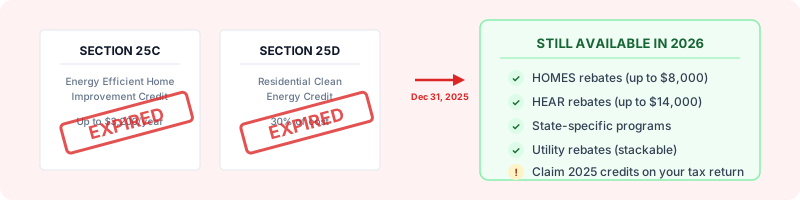
For over a decade, the Section 25D Residential Clean Energy Credit put a 30% tax credit on solar panels, battery storage, geothermal heat pumps, and wind energy systems — no dollar cap. A $30,000 solar installation netted a $9,000 tax credit. It was one of the most generous residential energy incentives ever written into federal law.
It's gone. The One Big Beautiful Bill, signed into law on July 4, 2025, terminated Section 25D for any property placed in service after December 31, 2025. If you're planning a solar installation in 2026, there is no federal tax credit waiting for you at filing time.
But if you did solar or battery work in 2025 or earlier — or if you have unused credits carrying forward from prior years — there's still real money on the table. This guide explains exactly what you can still claim, how carryforward works, and what replaces 25D for homeowners going forward.
The 25D Credit Is Expired: What That Means
The expiration is permanent, not temporary. This isn't a sunset provision that Congress needs to act on to keep in place — the One Big Beautiful Bill (Public Law 119-21) actively terminated the credit with a hard cutoff date. Absent new legislation, there is no 30% federal solar credit, no 30% battery storage credit, and no geothermal credit for property placed in service in 2026 or any year after.
The Hard Cutoff: December 31, 2025
"Placed in service" is the legal standard. For residential solar, this means the system was installed and operational by December 31, 2025. Key distinctions:
- Contract signed in 2025, installation January 2026 → Does NOT qualify. Date placed in service is what matters, not contract date.
- Partial installation in 2025, completion in 2026 → Only the portion placed in service by December 31, 2025 qualifies. This is rare for residential projects but matters for battery storage added to an existing solar array.
- Solar panels installed in 2025, monitoring system activated January 2026 → Qualifies if the system was generating power before year-end. The monitoring is not the "placed in service" date.
If there's any question about your installation date, your solar installer should have documentation — the interconnection approval or utility permission to operate (PTO) letter is often used as the authoritative placed-in-service date.
What the 25D Credit Covered
Before getting into what's still claimable, it helps to understand what the 25D credit actually covered. The credit applied to a broader set of technologies than most homeowners realize:
| Technology | 25D Credit (for 2025 and prior) | Status in 2026 |
|---|---|---|
| Solar panels (photovoltaic) | 30% of installed cost | Expired |
| Solar water heaters | 30% of cost | Expired |
| Battery storage (3 kWh or more) | 30% of cost | Expired |
| Geothermal heat pumps | 30% of cost | Expired |
| Small wind turbines | 30% of cost | Expired |
| Fuel cells | 30% of cost | Expired |
The 30% rate applied with no dollar cap. A $50,000 geothermal system netted $15,000. A $12,000 solar array netted $3,600. For large solar installations, this was often the single largest rebate available — more than any state or utility program.
For context on the full rebate landscape that remains active, see our energy rebates 2026 overview.
Claiming the Credit for 2025 Work on Your 2025 Tax Return
If you had a qualifying system placed in service before January 1, 2026, you absolutely should claim the 25D credit on your 2025 federal tax return. This is legitimate, legal, and worth potentially thousands of dollars. The expiration of the credit for future installations does not affect credits earned on past installations.
How to Claim It
The 25D credit is claimed on IRS Form 5695 (Residential Energy Credits). Attach it to your Form 1040 when you file your 2025 return. The form has separate lines for each technology type.
Calculating Your 2025 Credit
| What You Spent in 2025 | Credit Rate | Credit Amount |
|---|---|---|
| $20,000 solar installation | 30% | $6,000 |
| $8,000 battery storage | 30% | $2,400 |
| $28,000 geothermal heat pump | 30% | $8,400 |
What counts as "cost" for the 25D credit includes equipment, installation labor, permitting fees, and interconnection costs. For solar specifically: the panels, inverter, racking, wiring, and installation labor all count. The cost of an upgraded electrical panel that was specifically required for the solar installation can also be included.
If you installed solar AND battery storage in 2025 as part of the same project, both qualify at 30%. If you added battery storage to an existing solar array in 2025, the battery storage still qualifies at 30% — you don't need to have installed new solar panels in the same year.
The Credit Is Non-Refundable
This is important. The 25D credit reduces your federal income tax liability dollar-for-dollar. But if your credit exceeds your tax bill, you don't get a refund for the difference. The excess carries forward (more on that below).
Example: Your 2025 solar installation generates a $9,000 credit. Your 2025 federal tax liability (before credits) is $6,000. You use $6,000 of the credit to zero out your tax bill. The remaining $3,000 carries forward to 2026. You won't get a $3,000 check — you'll get a $3,000 reduction in your 2026 federal taxes.
Carryforward Rules: Can You Use 2024 Credits in 2026?
Yes — and this is where the expiration gets more nuanced. Unused 25D credits from prior tax years can still carry forward and be used in 2026 and future years. The expiration of the credit for new installations does not cancel out carryforward amounts you've already earned.
How Carryforward Works
- You installed solar in 2023. Your total 25D credit was $9,000.
- Your 2023 tax liability was $5,000. You used $5,000 of the credit; $4,000 carried forward to 2024.
- Your 2024 tax liability was $3,000. You used $3,000 of the carryforward; $1,000 carried forward to 2025.
- Your 2025 tax liability was $2,000. You use the remaining $1,000 carryforward; your 2025 credit balance is now $0.
Carryforwards don't expire at some fixed date. They carry forward until used or until you no longer have federal income tax liability. The OBBB's expiration of the credit for new installations in 2026 does not eliminate your previously earned carryforward balance.
Track Your Carryforward Amount
Check Form 5695 from your prior year return — there's a line specifically for the carryforward amount. If you've been claiming 25D credits over multiple years, your tax software or accountant should be tracking this automatically. If not, pull your Form 5695 from the past 3-5 years and add up what hasn't been used.
State Tax Credits May Also Apply
Several states have their own residential clean energy tax credits that are separate from the federal 25D credit. These state credits may or may not have been terminated by state-level legislation. Check your state's tax authority or look at your state's rebate page for current information. New York, for instance, has a separate 25% state solar tax credit capped at $5,000 that operates independently of the federal program.
Filing Deadlines You Cannot Miss
To claim 2025 work on your 2025 tax return, you need to file — or extend — by the following deadlines:
| Deadline | Date | What It Covers |
|---|---|---|
| Standard filing deadline | April 15, 2026 | 2025 federal tax return with Form 5695 |
| Extension deadline | October 15, 2026 | If you file Form 4868 by April 15 |
| State return deadlines | Varies by state | Most states mirror the April 15 federal deadline |
Filing for an extension buys you six more months to file, but not to pay. If you owe taxes, you still need to estimate and pay by April 15 even if you get an extension. The extension just extends the paperwork deadline.
Amended Returns
Missed claiming 25D on a prior year return? You can file an amended return (Form 1040-X) to add the credit. The IRS allows amendments for up to three years after the original filing deadline. That means 2022 installations can still be claimed via amendment filed by April 15, 2026 (three years from the April 15, 2023 deadline for 2022 returns). Don't leave prior-year credits unclaimed — the IRS doesn't send you a reminder.
What Replaces the 25D Credit in 2026
Honestly? Nothing fully replaces it. The 25D credit was uniquely powerful: no dollar cap, no income limit, applied to a wide range of clean energy technologies. The programs that remain active in 2026 are meaningfully different.
What's Still Available for Clean Energy in 2026
| Program | Covers Solar? | Max Benefit | Income Requirement |
|---|---|---|---|
| 25D Credit (2025 carryforward) | Yes (prior year work only) | Unlimited (30% carried forward) | None |
| HEAR Program | No | $14,000 (heat pumps, panels, etc.) | 150% AMI or below required |
| HOMES Program | No | $8,000 (home energy reduction) | 150% AMI or below required |
| State solar incentives | Yes (varies) | Varies widely by state | Varies |
| Utility solar programs | Yes (varies) | Varies by utility | Varies |
For heat pump, insulation, and electrification projects, the HOMES and HEAR programs are substantial — up to $22,300 combined for a low-income household doing a full retrofit. But for solar specifically, federal support is gone. State and utility programs have to carry the weight.
Solar Panels Without the 30% Credit: Your Options
Solar installers are recalibrating their pitch. For years, the 30% federal credit was the centerpiece of every sales conversation. Now, the economics of solar still work — but they work differently. Here's what's still available for a 2026 solar installation:
State Solar Tax Credits and Rebates
Several states provide their own solar incentives that continue independent of federal policy:
- New York: 25% state tax credit up to $5,000 + NY-Sun incentive program
- California: Net Energy Metering 3.0 (NEM 3.0) + Self-Generation Incentive Program (SGIP) for battery storage
- Massachusetts: SMART program (Solar Massachusetts Renewable Target) — production incentives paid per kWh generated
- Maryland: Residential Clean Energy Grant, Residential Solar Equipment Property Tax Exemption
Net Metering
Most states still require utilities to credit solar customers for excess power sent to the grid. Net metering reduces your ongoing electricity bill and is factored into payback period calculations. The rate varies by state and utility — some pay retail rate, others (like California under NEM 3.0) pay a lower "avoided cost" rate that lengthens payback periods.
The Solar Rebate Calculator
Before writing off solar in 2026, run the state-specific numbers. Use our solar rebate calculator to see your estimated payback period based on your state's current incentives, your utility's rate, and current panel costs. In high-electricity-rate states like California, New York, and Massachusetts, solar still pencils out — it just takes longer without the 30% federal credit.
Why the Credit Ended: The OBBB Explained
The One Big Beautiful Bill (OBBB) was a fiscal reconciliation package signed by President Trump on July 4, 2025. It was designed to extend the 2017 Tax Cuts and Jobs Act provisions and make additional tax and spending changes. Among its provisions: termination of both Section 25C (Energy Efficient Home Improvement Credit) and Section 25D (Residential Clean Energy Credit) for property placed in service after December 31, 2025.
The OBBB's energy provisions were among the most contested portions of the bill. Proponents argued that the IRA energy credits had distorted energy markets and that the federal government should not be subsidizing specific technologies. Opponents argued the credits were essential to reaching clean energy goals and reducing household energy costs.
What wasn't changed: the HOMES and HEAR rebate programs. These are funded through Inflation Reduction Act appropriations — separate from the tax code — and they survived the OBBB. For more on that distinction and the full political context, read our OBBB energy changes guide.
Executive Order 14154, issued January 20, 2025, had briefly frozen IRA funding. Federal courts ordered reinstatement of the freeze in February 2025. By mid-2025, HOMES and HEAR funding was flowing again through state programs. The OBBB then separately addressed the tax credit side — different mechanism, different outcome.
Action Steps Based on Your Situation
| Your Situation | Action |
|---|---|
| Solar installed before Dec 31, 2025; haven't claimed credit | File Form 5695 with your 2025 tax return by April 15, 2026 |
| Have unused 25D carryforward from 2022-2024 | Claim the carryforward on your 2026 tax return; check Form 5695 from prior years for the amount |
| Solar installed in 2022-2024; never claimed the credit | File amended returns (Form 1040-X) — deadline for 2022 is April 15, 2026 |
| Planning solar installation in 2026 | No federal 25D credit available; use solar calculator to model state incentives and net metering payback |
| Planning heat pump, insulation, panel upgrade in 2026 | HOMES and HEAR programs active; check your state's page for status and use the calculator for amounts |
| Unsure if 25D credit applies to your 2025 project | Check installation date documentation; consult a tax professional for edge cases |
The bottom line: the 25D credit is over for new installations, but money already earned through prior installations can still be claimed or carried forward. Don't leave that on the table. And if you're planning new clean energy work in 2026, the HOMES and HEAR rebate stack is where the federal money lives now.
See What Federal Rebates You Still Qualify For
The 25D credit is gone, but HOMES and HEAR are still funding home upgrades. Check your eligibility in under 60 seconds.